
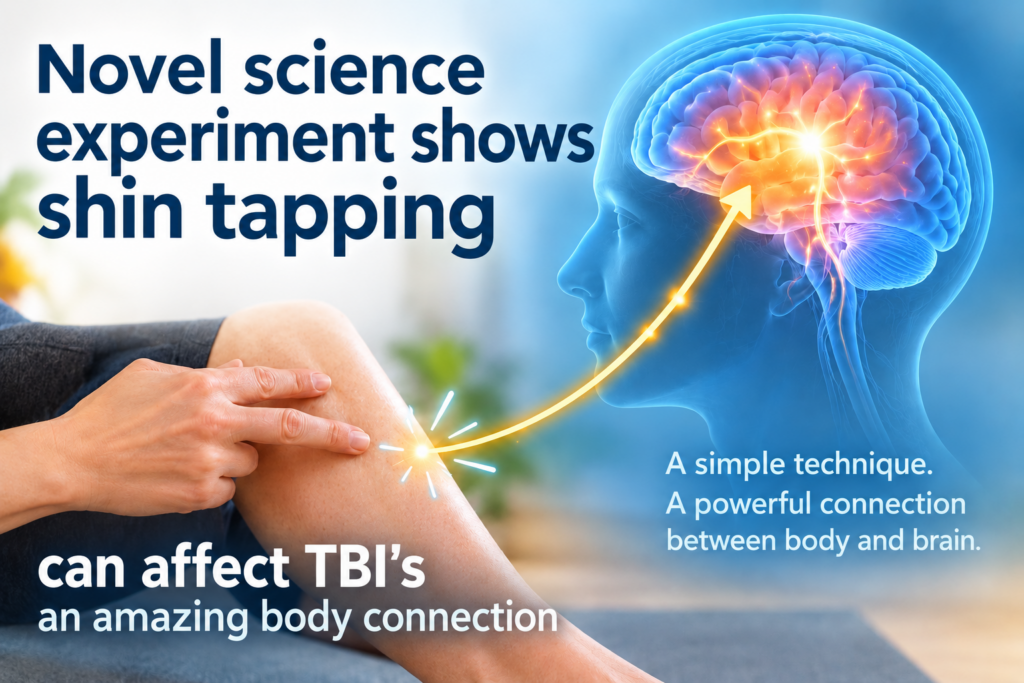
Disclaimer: This article talks about a novel (unique and unproven) way to treat brain injury. In no way should you try this. But it is very interesting how the body can send signals and how those signals are generated.
Tap your shin and heal your Traumatic Brain Injury. Now that just sounds wrong. But below is a study that showed it worked in pigs and mice. Which are not humans, but it’s interesting to me.
If you know my story, I had a nice normal life. A drinking 18 year old used my car as a stop sign at a high rate of speed and I was not so good after that. In the end it was my un-diagnosed brain injury that caused most of the problems. I had a bunch of broken bones that the Doc’s thought was the issues. Well they did cause problems also, but 35 years ago medicine was not into brains like now.
All that to say, my exploration of martial arts for the last 45 years had a section where I (and a few kung-fu buddy’s) would tap/hit our shins with wood and roll metal bars up and down them. It’s a thing to toughen the bones. Looking back on it – DO NOT DO IT.
I actually stopped when I read a study on Muay Thai Kickboxers having a higher rate of bone cancer, they think from doing ‘bone hardening’ conditioning.
I imagine this tapping in the study is nothing like what we did. But it is an interesting way the body can send signals to different parts of itself.
I recently saw some AI animations of how they think acupuncture works under the skin. It was super interesting, likely no where near as complicated as it really is, but interesting. I imagine this tapping is the same. The human body in a thin sliver can be understood. But if you look at the whole person, I think it is impossible.
Here is the article I got the idea from and below is the related journal entry.
How Gentle Tapping on the Shin Heals the Brain
The shin bone’s connected to the… brain?
By Jake Currie
3:00 PM CDT on September 25, 2026
Your brain is talking to your skeleton, and more than you probably realize. For example, doctors have long noticed something odd about people with traumatic brain injuries—their bones heal faster. When some brain cells are damaged, they release vesicles filled with proteins that travel to the bone stem cells and stimulate growth. Naturally, researchers began to wonder: If damaged brains can heal bones, can bones heal damaged brains?
To find out, researchers from Southern Medical University in China flipped the script on TBI-accelerated bone growth. They artificially caused traumatic brain injuries and strokes in the brains of mice and pigs. They then outfitted the brain-damaged animals with electronic devices that would rhythmically tap on their shin bones a couple times a second for five days.
Remarkably, it worked. According to their study recently published in Nature Neuroscience, the tapping reduced brain cell loss, promoted neuron growth, and relieved chronic inflammation. It also increased both animals’ survival time and improved their motor function and ability to navigate mazes, suggesting the process led to less memory loss.
The researchers traced the effects to a relatively large protein in bone cells called PIEZO1. This propeller-shaped protein has three spiral “blades” that curve upward surrounding an ion channel. When pressure is applied, the blades flex down and the ion channel opens, letting in positively charged signalling elements like sodium, potassium, and calcium. In their tests of animals without PIEZO1, the team found none of the healing benefits of shin tapping.
It’s a little strange, but not if you consider that bones act sort of like endocrine organs. They actively regulate mineral levels, secrete a growth factor that acts on other organs, and hormones that can lower blood glucose and boost testosterone. The endocrine system operates via feedback loops, so in a way it would be even weirder if the brain-bone axis only went one way.
But it’s still weird.
Enjoying Nautilus? Subscribe to our free newsletter.
Tibial bone compression promotes recovery after brain injury through osteocyte PIEZO1
- Zhiqing Cai,
- Zhimin Zhang,
- Yuxin Wang,
- Shencai Liu,
- Jiarong Leng,
- Yun Chu,
- Jihang Liu,
- Yingying Fang,
- Bochong Chen,
- Wenquan Liang,
- Hong Wang,
- Lu Zhang,
- Weiguo Zou,
- Fan Yang,
- Qiancheng Song,
- Di Lu &
- Xiaochun Bai
Nature Neuroscience (2026) Cite this article
Abstract
Traumatic brain injury (TBI) accelerates bone healing and induces heterotopic ossification, raising the question of whether an injured brain benefits from bone. Here we reveal that dynamic compressive tibial axial loading (DCTAL), a model of tibial bone compression, increased survival and promoted motor and cognitive recovery after stroke and TBI in mice, as well as in pig TBI models. DCTAL reduced neuron loss, attenuated chronic inflammation and astrogliosis and stimulated neuronal regeneration after TBI. Deletion of the mechanosensory channel Piezo1 in osteocytes reversed these benefits, while serum from DCTAL mice recapitulated them. Osteocytes transduced mechanical signals to directly secrete factors such as IL-1R2, APOL11a and HSP70, while indirectly increasing serum levels of BDNF, PF4 and dopamine. These factors synergistically protected against TBI. Altogether, we establish a bone–brain axis in which bone endocrine function can be modulated by mechanical forces to enhance brain repair after injury.
For more information talk to me at the clinic.
Be Well,
Ward Willison R.Ac.
allbodycare.com
Kelowna Acupuncture & Other Natural Therapies