

(and you can do something about one of them)
After 30 years in clinic I have made a list on how to live long and prosper. This article is for discussion purposes only. If you want to try anything written get proper medical advice for you specifically.
What is the number one thing to live a long and healthy life?
Get lucky!
The number one thing is luck. In all the ways you can imagine. To age well, the best thing you can have is luck.
Number two is fitness.
You can do a few things to up your lucky chances, which we will talk about, but really fitness is the one health tip that you get to act on. The good news is, it’s a big one because fitness doesn’t just help fitness. It benefits almost everything else along with it.
1. Luck. Which (can) suck.
The single biggest factor in how long you live is luck.
You didn’t pick your parents. You didn’t pick your genes, your birthplace, you (hopefully) were not born with 2 holes in your heart (my niece), whether a drunk driver drills into you on a Wednesday (which is what happened to me). You didn’t pick the family history of this cancer (my mom) or that immune thing. A big chunk of your health outcome was decided before you had any say at all.
So why mention it? Two reasons.
First, it can take some pressure off. If a healthy person you know drops dead at 58 and a guy who smoked for 40 years is still golfing at 90, that’s not a moral failure or a secret superfood. That’s the deck of cards. You play with the cards you are dealt, not against the people who got better ones. Some people get exceptionally lucky with their genes, lives, etc.
Second, the legendary quote, “You miss 100% of the shots you don’t take,” Wayne Gretzky. Many confuse luck and fate with poor decisions and failure to act.
A personal example, I got hit by a car, I did wallow in self-pity from time to time. But it was up to me to get to treatments and do my ‘homework’ to regain my health. If I just said, “ow well bad luck, hit by car nothing I can do, I’ll just sit here and accept it.” I did have bad luck, but I had some agency to act to correct it. Many don’t and some can not and that can really suck.
2. Fitness. The one you actually control.
Here’s the part people miss. They treat fitness like it’s just one item on the health checklist. Eat well, sleep well, manage stress, exercise, floss, and so on down the line.
Nope. Fitness isn’t one item on the list. It’s the thing that quietly improves most of the other items for you.
Get more fit and watch what happens:
- You sleep better. Real, measured, deeper sleep. Exercise nudges your body temperature and your melatonin and your stress hormones in the right direction (sleep review, Nature 2025).
- Your mood lifts. Movement is one of the most reliable antidepressants we have, and it doesn’t come with a pharmacy bag of side effects. A brief example – Depression is a concentration of something, if you move/exercise that will break up that concentration and can ease depression.
- Your appetite and blood sugar behave. Fit muscle soaks up sugar out of your blood like a sponge. Less of it left sloshing around doing damage.
- Your head works better. More blood flow, more of the brain’s own fertilizer (a thing called BDNF-Brain-derived neurotrophic), better focus, better memory.
- Your organs get stronger. Heart, lungs, the whole plumbing system. A fit heart does the same work with fewer beats. Your heart is a muscle, like all the rest of them, generally the stronger it is the easier life is.
- Your immune system runs cleaner. A study on people with chronic insomnia found that four months of moderate aerobic exercise improved their sleep, dropped their depression AND shifted their immune markers, all at once (study here).
Fitness is the make your own luck by improving sleep, mood, appetite, cognition, circulation, organ strength, immunity. Get fitter and you get to improve them all. But I will probably make an article on each in the coming months as there are nuances for each.
That’s why I put fitness as the number two most important longevity factor behind luck and nothing else is close.
How much? The Goldilocks problem.
If a little fitness is good, is more better, should I go all in? Sign up for the Ironman, run ultras, train till I puke?
For the VAST MAJORITY of people, no! And here’s the science, which is a little more interesting than “more is always better.”
There’s very good evidence that the relationship between exercise and dying looks like a curve, not a straight line. Going from doing nothing to doing a little bit is the single biggest jump you will ever make.
It is so important to read and understand that, DO SOMETHING regularity.
But like most things too little-mostly bad, too much-mostly bad (extreme-exercise review).
A quote from https://www.jacc.org/doi/10.1016/j.jacc.2015.11.034 Habitual physical activity and regular exercise training improve cardiovascular health and longevity. A physically active lifestyle is, therefore, a key aspect of primary and secondary prevention strategies. An appropriate volume and intensity are essential to maximally benefit from exercise interventions
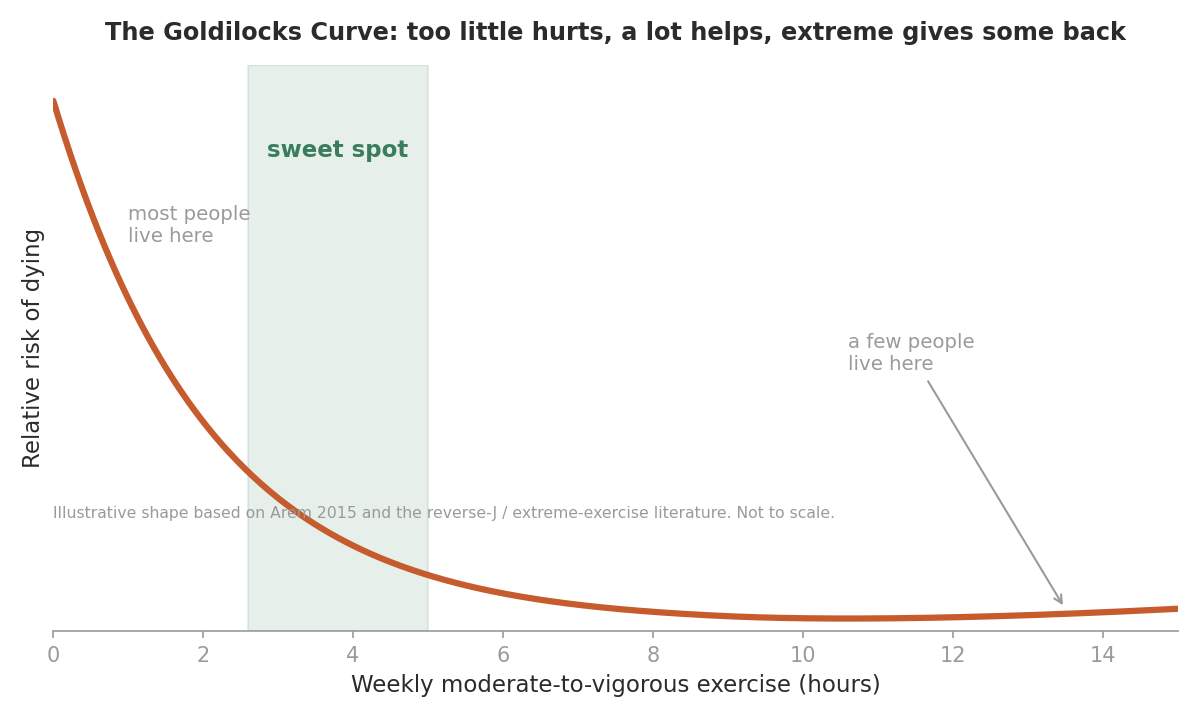
Illustrative shape. Sources: Arem 2015 and the reverse-J / “extreme exercise” literature.
Almost nobody reading this is at risk of exercising too much. The Ironman-injury zone is a rounding error. The entire rest of the population, the huge middle and left of that chart, does too little. That’s likely you. That’s your neighbour. That’s the guy who “means to get back into it.”
So the Goldilocks message isn’t “careful, don’t overdo it.” For 95 out of 100 people the message is “you are nowhere near the danger zone, get moving.” But do it safely.
And when I say fitness, I really mean fitness.
There’s a difference between “I went for a walk” and “I am a fit person,” and the second one is what actually predicts how long you live. However we ALL start somewhere, just start and go from there.
But to put a point on it a big Cleveland Clinic study tracked 122,007 people who did a treadmill test, then watched who died over the next decade-plus. The results are about as blunt as medical research gets (Mandsager, JAMA Network Open 2018):
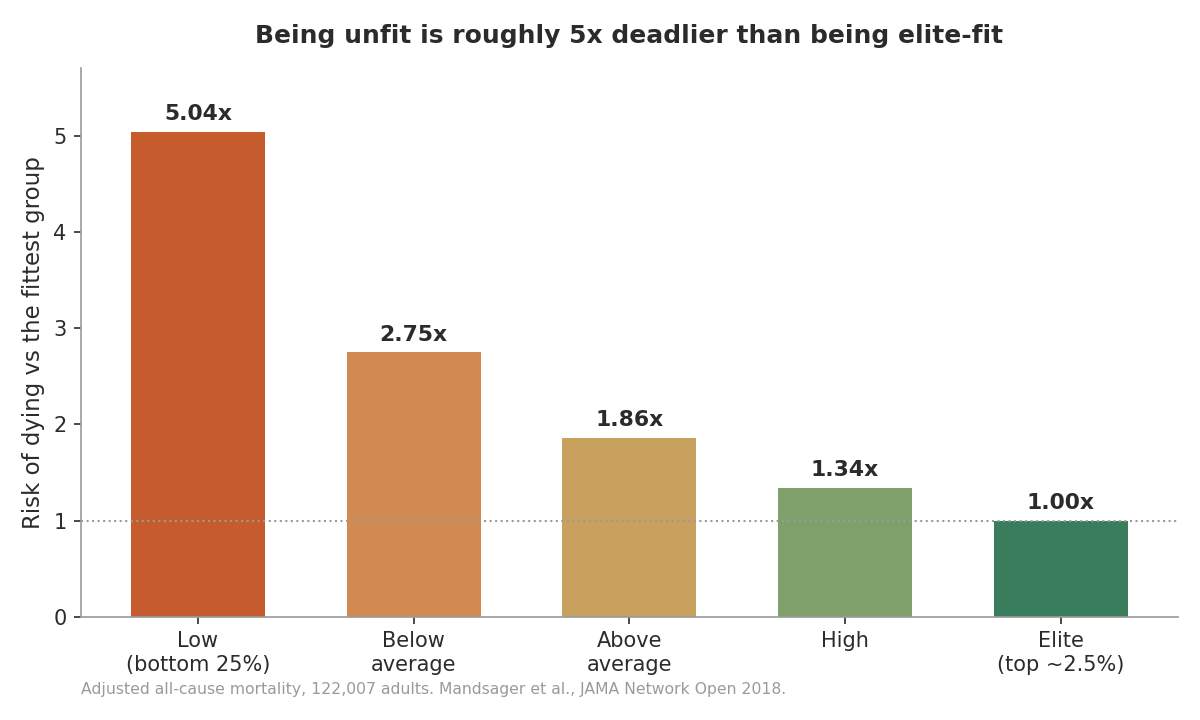
Adjusted all-cause mortality, 122,007 adults. Mandsager et al., JAMA Network Open 2018.
The least-fit group had roughly FIVE times the risk of dying compared to the fittest group. Not five percent. Five times! The researchers pointed out that being unfit was as dangerous as, or worse than, smoking, diabetes or high blood pressure.
And here’s the plot twist that sits right next to the Goldilocks curve. When you measure fitness itself (not hours logged, but how strong your engine actually is), the benefit had no ceiling in that study. The elite-fit did the best of anybody. A separate look at 750,000 veterans found every notch up the fitness ladder cut mortality another 13 to 15 percent, at every age.
So how do we square that with the Goldilocks curve? Chasing extreme training VOLUME has diminishing and eventually slightly negative returns. But being a genuinely FIT human keeps paying off the whole way up. You don’t need to run 100-mile races. You need to actually be fit, and stay fit, for decades.
I have told a few patients they were doing too much and all of them did have negative health events. It is a form of bad luck. Their stress management strategy involved fitness, they had an injury where they can not do exercise for a while and their lives just fell apart. Others had injury’s that ended their ability to move as before. However I have told thousands to exercise more.
While fitness is an EXCELLENT mode of stress management you must develop more than just fitness for a rounded life. But I will have to do another article on this topic. Back to this story.
So what do you actually do?
You pick something you can still be doing in ten years. The best exercise is the one you’ll repeat about a thousand more times. Try a bunch, really more the better and find some you like.
A few rules I give people:
- Make it age appropriate. Your body isn’t 25 anymore (unless it is), and that’s fine. Tai chi, qigong, a brisk walk with a friend, pickle ball, swimming, some resistance work so your muscles and bones don’t quietly melt away. All excellent. If you hire a trainer I suggest get one roughly your age and understands your stage of fitness.
- Make it something you don’t hate. If you dread it, you’ll quit. If you quit, it doesn’t count. A fun activity you’ll do for year’s beats the “perfect” program you’ll abandon in March.
- Include some huff-and-puff and some strength. You want the cardio engine (for the heart and lungs and brain) and you want the muscle (for blood sugar, bones, and not falling over when you’re 80). You don’t need both every day. You need both in your week.
- Show up more than you go hard. Consistency is boring and it wins. Success in fitness, like success in most things, is a lot of repetitive, unglamorous reps. A lot.
- Deal with the nagging stuff. If you’re carrying a cranky back, knee or hip, it will not fix itself while you sit there hoping. Make a plan. Improve your tone, balance, range of motion and strength and it will improve and if not you could go wild and try acupuncture.
The bottom line
Two things for this article. Luck, you got dealt some cards, and fitness, which is the one strong card you get to play every single day.
You don’t have to be an athlete. You have to be someone who keeps moving, on purpose, for the rest of your life. Do that and you’ll sleep better, think clearer, feel steadier, and hand your immune system and your organs bonus points. All from one habit.
The funny thing the better the fitness habit, the more lucky you will get.
You don’t get this year over again. Start today.
But don’t give up cookies, until you get to the clinic and then give them to me.
Be Well,
Ward Willison R.Ac.
www.allbodycare.com
Kelowna Acupuncture & Other Natural Therapies